Following an Early Report Without Rushing to Certainty
Following an early report without rushing to certainty helps you judge what a local story can support and what remains unsettled as it develops.
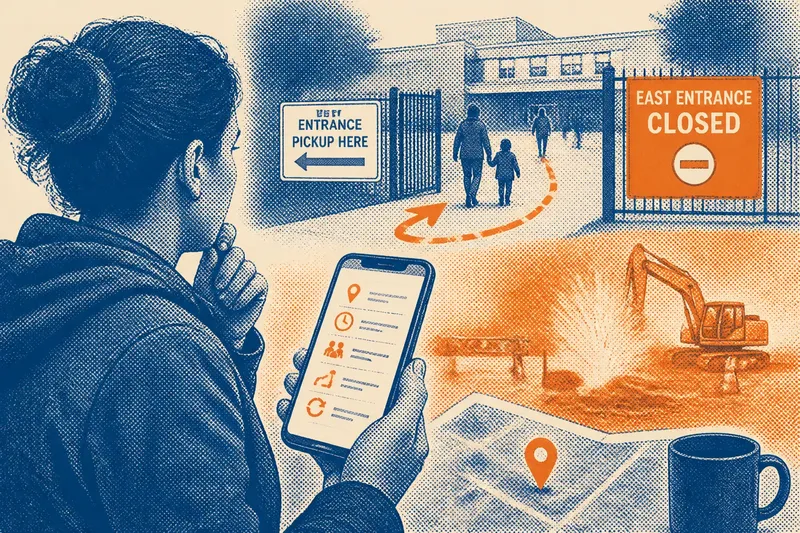
A school pickup notice changes at lunchtime: one entrance is closed, and a neighborhood post blames a nearby water main break. Following an early report without rushing to certainty means asking what the report actually helps you decide—not sorting every sentence into evidence categories.
Start with the local decision
Place-based news matters because it can change an immediate choice: which road to take, where to collect a child, or whether a public meeting is still happening. Begin with that practical question. It keeps a developing story useful without requiring you to settle its cause.
Find the details that affect your choice, such as the named street, building entrance, time period, or service. Keep the scale precise. A closure on one block does not tell you whether nearby streets are blocked, and a school notice about one entrance does not establish that the whole campus is inaccessible.
Look for the report’s own boundaries. Does it describe a single location, a neighborhood, or a whole district? Does it say the restriction is in effect now, or only expected? Those limits are part of the information, not minor wording.
Follow the report’s shape
Instead of keeping a running ledger of claims, notice how the story is built. A local report may move from an immediate disruption to its practical effects, then to explanations or wider context. That order can make a short account easier to read, but it can also leave important local questions outside the frame.
Check whether the report tells you who is affected and what action is available. A transit notice might identify a station entrance as closed while leaving the accessible route unclear. A county announcement might name a road but not say where drivers should turn instead. That gap is a useful question for the next update or an official service channel.
Think of a report like a street map: it shows a route and its boundaries, but not every reason a road is blocked. Use the information it supplies for the choice at hand, and avoid extending it beyond the area or time it describes.
Check the local frame
Place-based stories often rely on familiar landmarks, agency names, and neighborhood terms. Check that the place named in the headline matches the place described in the article. A broad label can make a disruption sound more widespread than the details support.
- Location: If the report names a specific intersection, use that boundary; if it gives only a broad neighborhood name, check a map or the issuing agency’s notice before assuming which blocks are affected.
- Time: If the notice says a change begins later, do not treat it as active yet; if the timing is absent, consult the relevant agency or venue before making a time-sensitive trip.
- People affected: If the report identifies a particular group or service, keep the claim limited to them; if it is unclear who is included, seek a direct notice before applying it to everyone nearby.
- Route or access: If an alternative entrance or detour is named, follow that specific direction; if none is given, check an official map or contact the site rather than guessing.
- Cause: If the report explains a cause with a named source, treat that as the explanation offered; if it gives no basis, do not let a neighborhood theory stand in for one.
- Update: If a later notice changes the location, timing, or access instructions, use the newer instruction for that detail; if it merely repeats the headline, look for a fuller notice before changing plans.
What should I check next?
Which source should I consult?
For a current closure or service change, check the agency, school, transit operator, or venue responsible for it. A local news report can supply context, while the organization managing the location is often the most direct place to verify current instructions.
What if the headline is broader?
Read the article text for its actual location and affected area. If the headline says a neighborhood is closed but the details name only one road, keep your understanding limited to that road until a direct notice says more.
How should I handle an unclear cause?
Keep the cause unresolved unless the report gives a clear basis for it. You can still act on a confirmed closure or service change without deciding why it happened.
When is another update useful?
Check again when a new detail could change your immediate choice, such as a revised entrance or reopening notice. If nothing relevant has changed, repeated checks may add noise rather than help.
Work through one update
Say you are planning to collect a child from a school whose notice says the east entrance is closed for the afternoon. A neighborhood post says a water main break caused the closure, but the school notice gives no cause. Your immediate question is where pickup will happen, not which explanation is correct.
You check the school’s latest notice and find that pickup has moved to the west entrance; it still does not name a cause. The practical answer is to use the west entrance and leave the cause unsettled. If a later school notice names a different pickup point, that instruction changes your plan; the neighborhood post does not.
Keep the useful boundary
A developing local report can be useful before every part of the story is clear. Keep its scope, timing, and practical instructions attached to the place they describe. When you search for following an early report without rushing to certainty, the aim is not to solve every unanswered detail; it is to make the next decision without stretching the report beyond its evidence.
For urgent or safety-related directions, rely on current instructions from the responsible local agency and contact a qualified professional or emergency service when the situation requires it. A clear boundary around what the report says can help you recognize when another source is needed.