Before the Byline: How News Desks Took Shape
Newsroom desk history helps explain how editorial work is organized and what a desk label can—and cannot—tell you about a regional report.
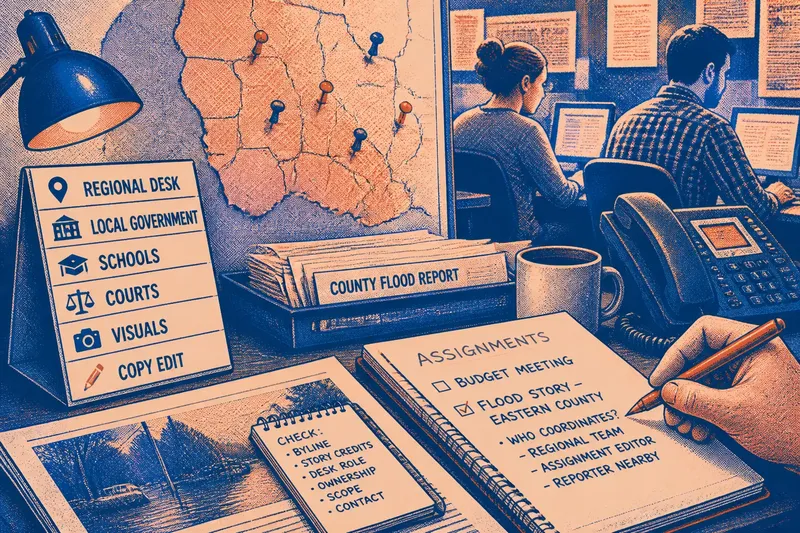
A county flood story arrives while the council reporter is covering a budget meeting. An editor has to decide who will coordinate the coverage, and the answer may be a regional team, an assignment editor, or a reporter already nearby. Newsroom desk history offers a useful way to understand that choice without treating one office chart as a universal model.
Newsroom desk history
The word “desk” can refer to a physical workspace, an editorial team, or a responsibility shared by staff. Its meaning depends on the publication. A small weekly may have one editor assigning and preparing stories, while a larger newsroom may divide those tasks among several teams.
One way to describe desk history is as a series of changing arrangements for assigning, editing, and publishing work. A newspaper might use city, state, sports, or copy desks; a radio newsroom might organize around programs and airtimes. These are examples of possible structures, not a record of how every newsroom developed.
For Eastern regional coverage, a newsroom may group work by county, subject, or publication stage. Another outlet serving similar communities may use a central editor and a network of contributors. The labels describe a newsroom’s own arrangement; they do not establish a standard that other outlets follow.
Common desk functions
Desk names can be useful when you treat them as descriptions of work rather than proof of a story’s quality or origin. Common functions include:
- Assignment: coordinates which staff members pursue scheduled events, incoming leads, or developing stories.
- Subject: organizes coverage around areas such as schools, courts, or local government.
- Geographic: coordinates reporting across towns, counties, or a wider region.
- Copy editing: prepares text for publication and may handle consistency and clarity.
- Visuals: coordinates photographs, captions, or other visual material when the outlet assigns that work to a team.
An outlet may combine these jobs, give them different names, or assign them without using formal desk labels. The practical question is what work the label refers to at that publication.
Read the newsroom structure
When a story names a desk or bureau, note the label, then look for what the outlet says that team does. If the story or staff page does not explain it, avoid guessing. A desk label alone cannot tell you who gathered each detail or who made a particular editorial decision.
- Check the byline. If it names a reporter or contributors, use those names to identify credited authors; if it names no one, look for an outlet or wire-service credit before attributing the work.
- Check the staff or contact page. If it defines a desk’s role, use that description; if it does not, treat the label as an internal term whose exact scope is unclear.
- Check story credits. If photographers, editors, or partner outlets are credited, note their stated contributions; if credits are absent, do not assume who handled those tasks.
- Check the publication’s ownership page. If it names an owner or parent organization, use that information to understand control; if it does not, do not infer ownership from a bureau or desk name.
- Check corrections and update information. If the story names a contact or editor, use that route for a question; if it does not, use the outlet’s published contact channel and ask which team handles follow-up.
- Check how the story describes its reach. If it says coverage spans several communities, look for the places named in the report; if the scope is not clear, avoid assuming one desk represents every community involved.
Say a fictional county outlet has one editor, a reporter covering schools, and a contributor in a neighboring town. The editor assigns the reporter to a school-board meeting, asks the contributor to confirm a road name mentioned in the agenda, and publishes the report with both contributors credited. The resulting byline and story credits tell the reader who is named as doing the reporting; they still do not reveal every internal editing decision. This invented situation shows why a desk label is only one part of the newsroom’s public record.
Desk labels and regional reporting
A geographic desk may coordinate reports from several towns, while a subject desk may organize coverage of an institution such as a school district. Either arrangement could help staff coordinate related assignments, but the label alone cannot establish how much local knowledge a particular story reflects.
When reading a report, separate the newsroom’s organizational map from the evidence the story provides. Ask which places it names, which contributors it credits, and whether it explains the local institutions relevant to the subject. Those questions concern the published report, rather than assumptions about how a desk works behind the scenes.
What desk labels answer?
Does a desk name identify the reporter?
Not necessarily. A desk name usually describes an editorial unit or responsibility, while a byline identifies credited authors. If the byline is absent or unclear, the desk label does not fill that gap.
Did every outlet use the same structure?
No single desk chart applies to all publications. An outlet’s format, staffing, and chosen responsibilities can shape its own arrangement, so use its published descriptions rather than assuming another newsroom follows the same pattern.
Does a local bureau show who owns the outlet?
No. A bureau label describes a reporting or editorial presence, not ownership. Check the publication’s ownership information for details about its owner or parent organization.
Can a desk label show who edited a story?
Only if the outlet makes that role clear. Look for an editor credit or an explanation of the desk’s responsibilities; if neither appears, ask the outlet rather than assigning an editor based on the label.
Use the label carefully
A desk is like a kitchen counter: it gives work a place to land, but it does not tell you who prepared every dish. Newsroom desk history can help readers recognize that editorial responsibilities may be grouped in different ways. For a specific Eastern regional report, use the publication’s own description of its desks and keep that internal structure separate from what the story itself credits.
When the arrangement remains unclear, ask a narrow question: which team does this label name, and what responsibility does the outlet assign to it? Newsroom desk history is most useful when it helps you make that distinction, rather than stand in for information the publication has not provided.