Headline, Standfirst or Caption: Where Context Gets Cut
Learn how headline, standfirst and caption divide a local report’s context, so you can read compressed wording without mistaking it for the whole account.

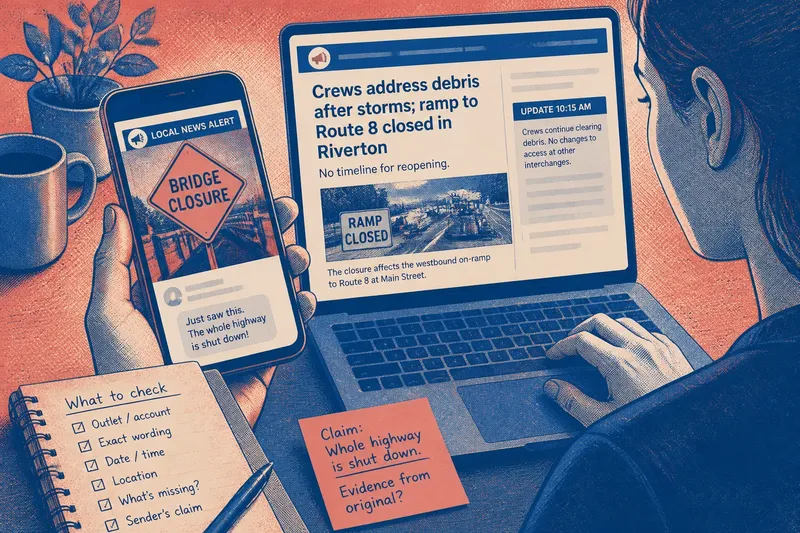
You open a local news page on your phone and see a headline about a road closure, a standfirst naming the affected area, and a photograph caption that identifies a nearby intersection. The pieces seem to describe one event, but each is doing a different job. To read a headline, standfirst and caption without losing context, treat them as separate entry points—not interchangeable summaries.
What does each part do?
A headline signals the story’s main subject and angle. It helps a reader decide what the report is about, but its small space means it cannot carry every qualification, source, or consequence.
A standfirst, sometimes called a deck or summary, sits beneath the headline and adds a little more information. It may identify who is affected, explain the immediate development, or provide a key detail that the headline leaves out. It is still compressed display text, not a substitute for the report.
A caption explains an image or other visual element. At its most basic, it identifies what the image shows, where it was made, or who appears in it. A caption can also connect the image to the story, but it should not make a photograph prove more than it depicts.
Think of the three parts as labels on a folder, not the documents inside it. The labels help you find your way; the report supplies the fuller account.
Why can they differ?
These parts are written for distinct purposes and may be edited at different points in production. A headline needs to name the central development quickly. A standfirst can add a second detail. A caption must describe the particular image, which may be illustrative, archival, or focused on one location within a wider story.
That division creates room for useful detail, but it also creates seams. A headline may use a broad place name while the caption identifies a specific block. A standfirst may describe a proposal, while the image shows an existing facility. Those differences are not automatically evidence of an error. They are prompts to check what each phrase refers to.
Pay attention to the nouns and verbs. “Council considers,” “council approves,” and “work begins” describe different stages. A headline can compress a process into a short phrase, so the body text matters when the distinction affects what happened or what happens next.
What context gets cut?
Compression often removes the boundaries around a claim. A headline may say “water service disrupted” without naming which streets or how the disruption is defined. A standfirst may identify the affected district but omit whether the notice comes from a utility, a council, or residents. A caption may name a town without making clear that the photographed site is only one part of a larger area.
Geographic wording deserves particular care in Eastern regional coverage. “The East,” “the eastern region,” a county, a city, and a neighborhood can refer to different boundaries. A report may concern a regional authority, while the display text names the town where a meeting or incident occurred. Do not assume that a place named in the headline is the only place affected.
Time can disappear too. “Residents face delays” might refer to a new decision, a continuing problem, or a forecast. A photograph could have been taken earlier than the report’s current development. Look for dates, time references, and wording such as “proposed,” “under way,” or “expected” in the full account.
Other context that may be trimmed includes uncertainty, a response from another party, the difference between an allegation and an established finding, and the limits of a cited document. If any of those distinctions could change your understanding, read the relevant paragraphs rather than relying on display text.
How should I read the headline?
Does the headline state a fact or a claim?
Check whether the wording attributes an assertion to someone or presents it as established. A phrase such as “Residents report foul smell” signals a reported experience; “Foul smell linked to site” makes a stronger connection. Open the report to see what evidence and responses support that wording.
What does the place name refer to?
Look for the precise location in the opening paragraphs and map references, if provided. A broad regional label may describe the authority or topic rather than the exact site of an event.
Is the verb precise?
Separate a proposal from a decision, a decision from implementation, and an announcement from a completed change. If the headline uses a broad verb, find the sentence in the report that says what action actually occurred.
What is missing from the short version?
Ask which qualification would matter most: who made the claim, who is affected, what remains uncertain, or what happens next. Use that question to guide your reading instead of treating the headline as a complete account.
What should a standfirst add?
A useful standfirst gives the headline a second layer without simply restating it. It may name the decision-maker, indicate the affected group, or explain why the development matters locally. Compare its information with the headline: does it narrow the subject, clarify the stage of events, or introduce a relevant detail?
Notice what it does not establish. A standfirst that says a plan “could reshape services” may describe an expected effect, not a final outcome. The report should explain the plan’s status and who has authority over it. A standfirst’s confident tone does not remove the need to check whether the text describes a possibility, an intention, or a completed action.
Say you see a headline reading “Market access changes next week” and a standfirst explaining that a town council has approved a trial traffic arrangement. The report then states that the change applies to one entrance, while other routes remain open. The useful reading is not that the display text is necessarily wrong; it is that the body supplies the boundary needed to understand “market access.”
What can a caption tell me?
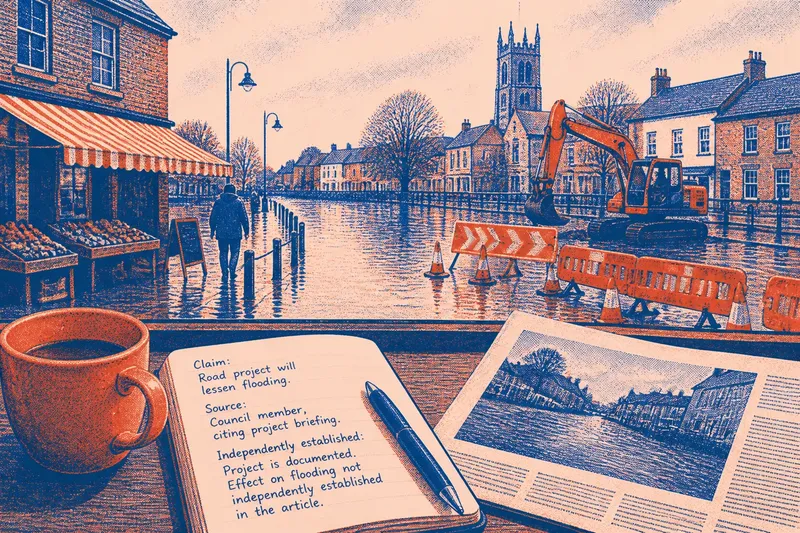
Start with the caption’s basic claims: who or what appears, where the image was made, and when, if a date is given. Then distinguish visible details from added interpretation. A photograph of a closed gate can show a gate closed at that moment; by itself, it cannot establish why it is closed, how long it will stay that way, or whether all nearby entrances are affected.
Check whether the caption describes an image from the current event or uses a file photograph. Labels such as “archive image” or “file photo” indicate that the picture provides background rather than a direct visual record of the latest development. If the caption identifies a person, compare the name and role with the report’s text.
Also check that the caption and headline point to the same place and event. If one refers to a village and the other to a district, the distinction may be sensible, but the report should make their relationship clear. Do not use a caption to infer a broader condition from one visible scene.
What if the parts conflict?
When wording appears inconsistent, first identify the exact mismatch. Is it about location, timing, the status of a decision, a person’s role, or what an image depicts? Naming the difference helps prevent a vague impression of contradiction from replacing a specific question.
Next, read the relevant section of the report and check any embedded document or linked notice that the text relies on. Give more weight to precise, attributed details in the body than to a compressed phrase, while still noticing if the body itself leaves the issue unresolved. A headline and caption may refer to different moments or places; the report should explain that distinction where it affects the story.
Imagine a headline says “Eastbank school closes,” while the caption identifies a temporary classroom at a school in a neighboring ward. You read the story and find that the closure applies to one building, not the whole school, and that the photograph is from a separate site used during the disruption. The next useful move is to check whether the article clearly explains those relationships; if it does not, send the newsroom a concise question naming the unclear building, place, and claim.
For a clarification, quote the wording and ask what it refers to. “Does ‘Eastbank school’ mean the main building or the entire school?” is more actionable than “This is confusing.” If an editor corrects or updates the display text, check whether the article also explains any material change.
How can I read quickly?
Use a short sequence when you are scanning a local report:
- Read the headline for the subject and action, then mark any broad or ambiguous wording.
- Read the standfirst for the added detail, especially the named authority, affected group, or event stage.
- Read the caption as a description of the specific image, not as proof of the whole story.
- Open the body text and locate the paragraph that explains the claim, decision, or event.
- Check place names and time references against the report’s own details.
- If a meaningful mismatch remains, ask the newsroom a precise question rather than filling the gap with an assumption.
This approach is especially useful when a local report names several settlements, agencies, or stages of a public decision. The headline, standfirst, and caption can orient you, but the body is where their relationship should become clear. Reading each part for its proper role makes compressed wording easier to use—and easier to question—without mistaking it for the whole account.